Operations · EXP-12
PAUSE: steering before the first edit bought nothing here
Intercepting a coding agent just before its first edit, for one planner pass, is reported to raise resolution by double digits. In our substrate the baseline needed no steering (100% unaided), the pass cost 2.45× the tokens, and on the second model the steered arm produced no deliverable at all.
Verdict against the frozen bar
Bar missed; validity gate missed. The baseline solved 100% of tasks unaided on both models; the steering pass cost 2.45× the tokens on the main run and collapsed deliverable production on the second model (0 of 17).
Coding agents commit to an approach long before they commit code: by the time the first source edit lands, a median of 60% of the trajectory has already gone into exploration and testing. The paper behind this experiment, Viral Patel and colleagues' "PAUSE: Search-Free Steering of Coding Agents Before Their First Source-Code Edit" (arXiv 2610.29870), intercepts that first edit for a single planning intervention: a separate Planner reads the task and the pre-edit transcript, writes one repair plan, and the same agent resumes with it. On SWE-bench Verified the authors report resolution gains of up to 16.8 points, and 35.4% recovery of failed trajectories offline.
A single well-placed review before commitment is an attractive shape for our own delivery lanes. This experiment tested whether the gain appears when the transcript, the lean, and the steering pass are all placed in front of the model in our one-shot substrate. It did not, and on the second model the treatment itself did damage.
What we tested
Eighteen synthetic coding tasks, each with a recorded pre-edit transcript that leans toward a flawed first edit (the deciding evidence is present in the transcript, but the trajectory's momentum points the wrong way). Three arms, three repetitions, 162 runs on Gemini 3.8 Flash:
- Arm A: the executor continues from the transcript unaided.
- Arm B: self-reconsideration. The executor writes its own brief plan before continuing.
- Arm C: PAUSE. A separate Planner model reads the task and transcript and writes one repair plan; the executor resumes with the plan appended.
Replication on DeepSeek v4.1 Flash, 53 of 54 cells scored.
Results

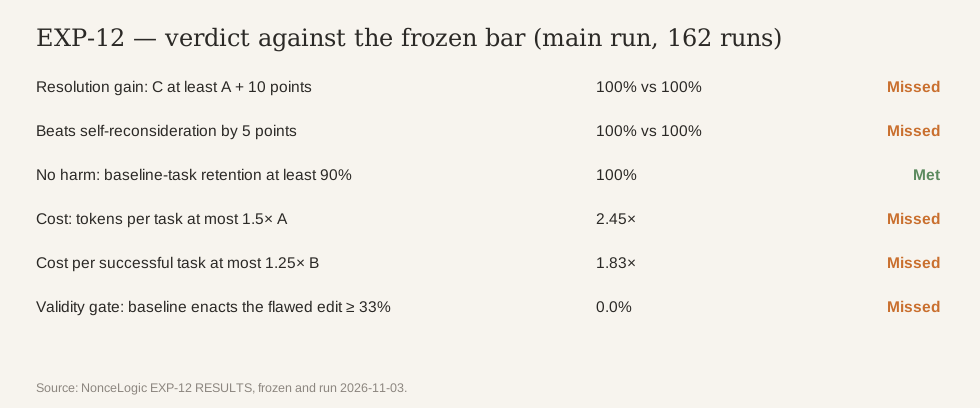
The main run sat at the ceiling: 100% success and 0% flawed-edit enactment in every arm. The baseline never enacted the leaned-toward flawed edit in 54 runs (or in the 18-run validity smoke), so the gate, which required at least 33% flawed enactment from the unaided baseline, missed, and the gain conditions were unmeetable. What the steering pass measurably did on the main run was cost:
- Tokens per task: A 408.7, B 547.6, C 999.6 (2.45× the baseline; Planner tokens were 46.4% of arm C's total)
- Arm B's self-plan and arm C's Planner plan both named the planted points correctly in inspected runs. The evidence was identified in every arm; only the deliverable economics differed.
Replication: the treatment broke
On DeepSeek the arms separated sharply. A and B again scored 100% success with 0% flawed enactment. Arm C scored 0 of 17: given the Planner's plan in its packet, the executor continued in prose and plan mode in every scored run and never emitted the deliverable format at all. The plans themselves were correct; the resumed executor never converted one into a deliverable in this pairing. One arm-C cell errored on transport and cannot change this: even scored as a success it leaves arm C at 1 of 18.
Per the frozen spec the two models are reported separately and never pooled, and here the disagreement is itself a result: arms A and B agree perfectly across pairings, while the PAUSE shape's effect is pairing-dependent, and in the harmful direction on the second pairing.
Limits
- Arm C measures one Planner plan steering a resumed deliverable call, not a tool-stream gate inside a live tool loop where an agent actually commits to edits over time. The paper's offline-recovery claim (35.4% of recorded failed trajectories) is not measured here at all.
- With the full pre-edit transcript in the packet, the unaided baseline synthesised the investigation on its own in 108 of 108 arm-A runs across main and replication. Either these transcripts make the deciding evidence too legible to need a steering pass, or both pairings are in a class that does not show the paper's failure at this scale. The data cannot distinguish those readings.
What we did with it
No incorporation, and no promotion: the first-edit PAUSE gate is not adopted, and neither is self-reconsideration as a steering requirement, because the baseline needed neither in this substrate. The guardrail written back: the paper's gain (Verified resolution 50.2% to 65.0% with one Planner pass) is not an assumed local effect. Locally, the pass cost 2.45× the baseline's tokens for no gain on one model and destroyed deliverable production on the other. A future test would need a live tool-loop substrate where lanes actually commit to a first edit, which is a new fixture task, not a relaunch of this one.
Source paper
Viral Patel, Boyin Tan, Jason Xue, Youcheng Sun. “PAUSE: Search-Free Steering of Coding Agents Before Their First Source-Code Edit.” arXiv:2610.29870